|
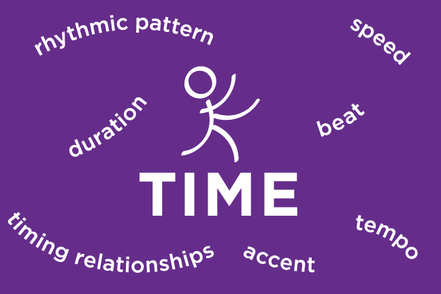
The keyword for the element of time is When? Human movement is naturally rhythmic in the broad sense that we alternate activity and rest. Breath and waves are examples of rhythms in nature that repeat, but not as consistently as in a metered rhythm.
Spoken word and conversation also have rhythm and dynamics, but these timing patterns are characteristically more inconsistent and unpredictable. Rhythmic patterns may be metered or free rhythm. Much of western music uses repeating patterns (2/4 or 3/4 for example), but concepts of time and meter are used very differently throughout the world. Dance movements may also show different timing relationships such as simultaneous or sequential timing, brief to long duration, fast to slow speed, or accents in predictable or unpredictable intervals. |
|
Time may also be organized in other ways including
- Clock time: The dance is based on units of seconds, minutes, and/or hours. For example, a certain section of a dance may be assigned a time such as 30 seconds into which all the choreographed movement must fit. A performance in a public setting may be set up to repeat continuously between 12:00 Noon and 1:00 PM.
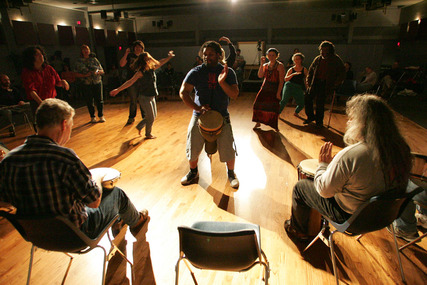
- Sensed time: Dancers pick up on each other's timing such as gradually increasing from a walking tempo to a running tempo by cueing off each other rather than a music score. Another example happens when dancers hold a group shape then spontaneously move out of it based on the group's organic impulse.
- Event-sequence: An internal or external event signals a change such as repeating a traveling phrase over and over until everyone arrives at a corner of the stage. You also see this at sports events when a touchdown triggers a dance cheer.
The Artist & Educator Institute - photo by Steve Mortensen
|
Dancers may take sight cues from each other to start the next phrase or listen for music cues. They may even take cues from an event such as a train whistle during an outdoor dance performance. The inherent rhythms in our movement and our aural landscape are a rich source of variation in dance.
Watch this video, then:


| ||||
Seeds of Wind (excerpt)
Choreography: Wynn Fricke in collaboration with the dancers
Music: Composed and performed by Peter O'Gorman
Dancers: Zenon Dance Company including
Mary Ann Bradley, Bryan Godbout, Greg Waletski, Amy Behm-Thompson
Hanging Chimes: Dean Hawthorne
Videography: Jim Peitzman
Choreography: Wynn Fricke in collaboration with the dancers
Music: Composed and performed by Peter O'Gorman
Dancers: Zenon Dance Company including
Mary Ann Bradley, Bryan Godbout, Greg Waletski, Amy Behm-Thompson
Hanging Chimes: Dean Hawthorne
Videography: Jim Peitzman